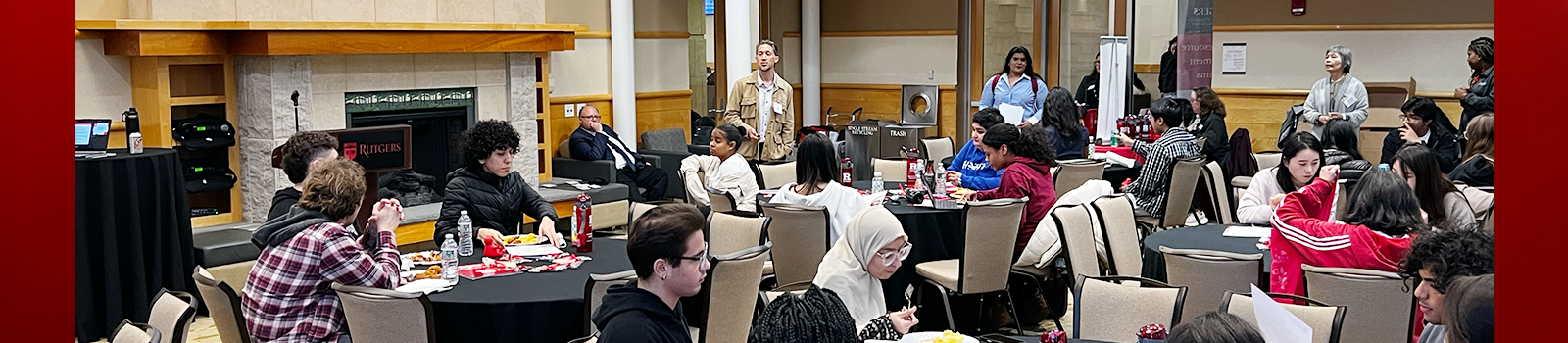
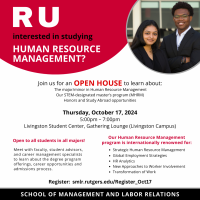

Join us on campus at Rutgers for an Open House to learn about the major/minor in Human Resource Management (HRM) and the master's program (MHRM), along with SMLR Honors and Study Abroad options!
Wed, 3/25/2026, 5:20pm – 7:20pm


If you're graduating in 2026 (May or August) we invite you to meet with some of our career coaches to discuss your thoughts and plans. SMLR Career Services can assist you in developing a strategy to approach graduation and search for a job!
Wed, 03/25/2026, 10:30am - 11:30am


Join Rutgers LEARN as we celebrate the work of Black women labor historians and union leaders’ organizing and intellectual work to transform the U.S. political economy. We will come together across labor organizations and academic disciplines to discuss Black women’s organizing across time and in multiple sites: unions, social organizations, scholarship, schools, and churches.
Sat, 03/07/2026, 10:00am-1:00pm


Join the Labor Studies and Employment Relations (LSER) department for our upcoming In-Person Open House to learn more about our undergraduate and master’s degree options, along with our 5-year program! Free pizza will be provided!
Wed, 03/04/2026, 4:30pm - 6:00pm


Join SMLR for our Lunar New year event on Tuesday, 2/17 in the Janice Levin Building Student Lounge on Livingston Campus.
Tue, 02/17/2026, 12:00pm-3:00pm


Social drinking and/or eating is both a common human behavior and a verified network generator from a variety of social network research around the world. Yet, its causal consequences are not well-established empirical evidence. To fill in this gap, the present study is designed to examine the causal effect of social drinking/eating networks (SDENs) on measures of generalized and institutional trust. Ongoing analysis of data from the 2017 module of the International Social Survey Programme (ISSP) shows that there is a great variation in both measures of trust and an individual’s frequency of attendance to SDEN occasions across the 30 ISSP member countries/regions in Americas, Asia, and Europe.
Tue, 02/10/2026, 4:00pm - 5:30pm


Whether you're looking for a job, internship, or just want to practice networking with employers, we encourage all SMLR undergraduate and graduate students, and alumni to attend this event! Meet with employers to network & learn about opportunities at these various organizations. Recruiters attending would like to share opportunities at their organization.
Tue, 02/10/2026, 11:00am-2:00pm
Come and learn tips on how to ace your next interview!
Thu, 01/29/2026, 12:00pm-1:00pm
Learn how to effectively search for a job or internship!
Wed, 01/28/2026, 1:00pm-2:00pm
Come and learn how to network during the upcoming career fairs and networking events!
Tue, 01/27/2026, 10:00am-11:00am