
About the Public School Collaborative
The Public School Collaborative brings together stakeholders in the public education system to work to improve teaching and learning. This effort is based on extensive research showing positive effects of collaboration on student performance, teacher turnover, and other important outcomes.
The Center’s faculty initiated the effort in 2013 by convening representatives of the state associations of School Boards, School Administrators, Principals and Supervisors, and the two teachers unions (the New Jersey Education Association and the American Federation of Teachers-NJ). In the past decade more than thirty New Jersey districts have been trained in the skills of collaboration, have started school- and district-level leadership teams and have embarked on new initiatives for the improvement of teaching and learning. Among the most recent cohort is the state’s largest district, Newark Public Schools, where we have organized 3 days of workshops for all 64 schools in 2024-26.
Since 2013 the Public School Collaborative has:
- Published a series of peer-reviewed research studies (detailed below) showing the positive effects of collaborative change on student achievement, teacher turnover, and other important outcomes.
- Provided 4-5 day Capacity Building Workshops for 32 districts.
- Built a team of 30 peer facilitators – including active teachers, union leaders, principals and other administrators, superintendents, and school board members – to help their own schools and others implement the structures and processes of collaboration.
- Convened sixteen Inter-District Conferences to share learnings and review progress, thus building a larger network of relationships and support extending throughout the state.
- Worked with the South African teachers and principals unions, the Department of Basic Education, and the Education Labour Relations Council to extend the model throughout that country’s nine provinces.
- Hosted a national gathering of collaborative reform efforts to develop a model for scaling beyond single schools, districts, or states - in order to impact national educational systems.
- In 2024, published a book with the Harvard Education Press on the research and practice behind this work. This book won an American Library Association Choice Award as an Outstanding Academic Title of 2024.
- As the initiative spread beyond New Jersey and encompassed an increasing array of stakeholders, the name was changed in 2024 to the “Public School Collaborative.”
Current Activities and Events
September 2026 Update
The Public School Collaborative at Rutgers' Center for the Study of Collaboration grew substantially in 2025 and has plans to continue that trajectory through 2026: providing capacity-building training to experienced and new districts; organizing inter-district learning meetings; conducting training for peer facilitators in New Jersey and South Africa; and coordinating ongoing research in both countries. We now support 32 districts in New Jersey and a national effort in South Africa. We also published a book with the Harvard Education Press, documenting the work through 2024, and a book chapter currently in press.
A summary of our activities for the past 18 months
The Collaborative model includes these key elements:
1. Daylong Capacity-Building Workshops.
We offer a sequence of four days of workshops over two years for new entrants to the Collaborative. We also provide as-needed development workshops for experienced districts.
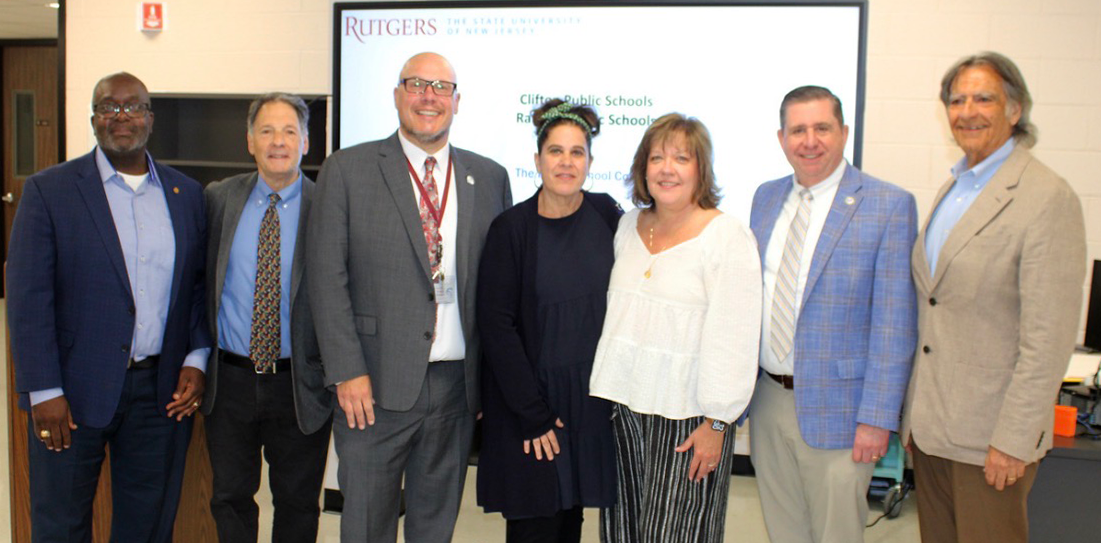
In the last 18 months we conducted workshops for 107 Schools in 14 New Jersey Public School Districts, for a total of 216 Days of Capacity Building.
2. Inter-District Conferences
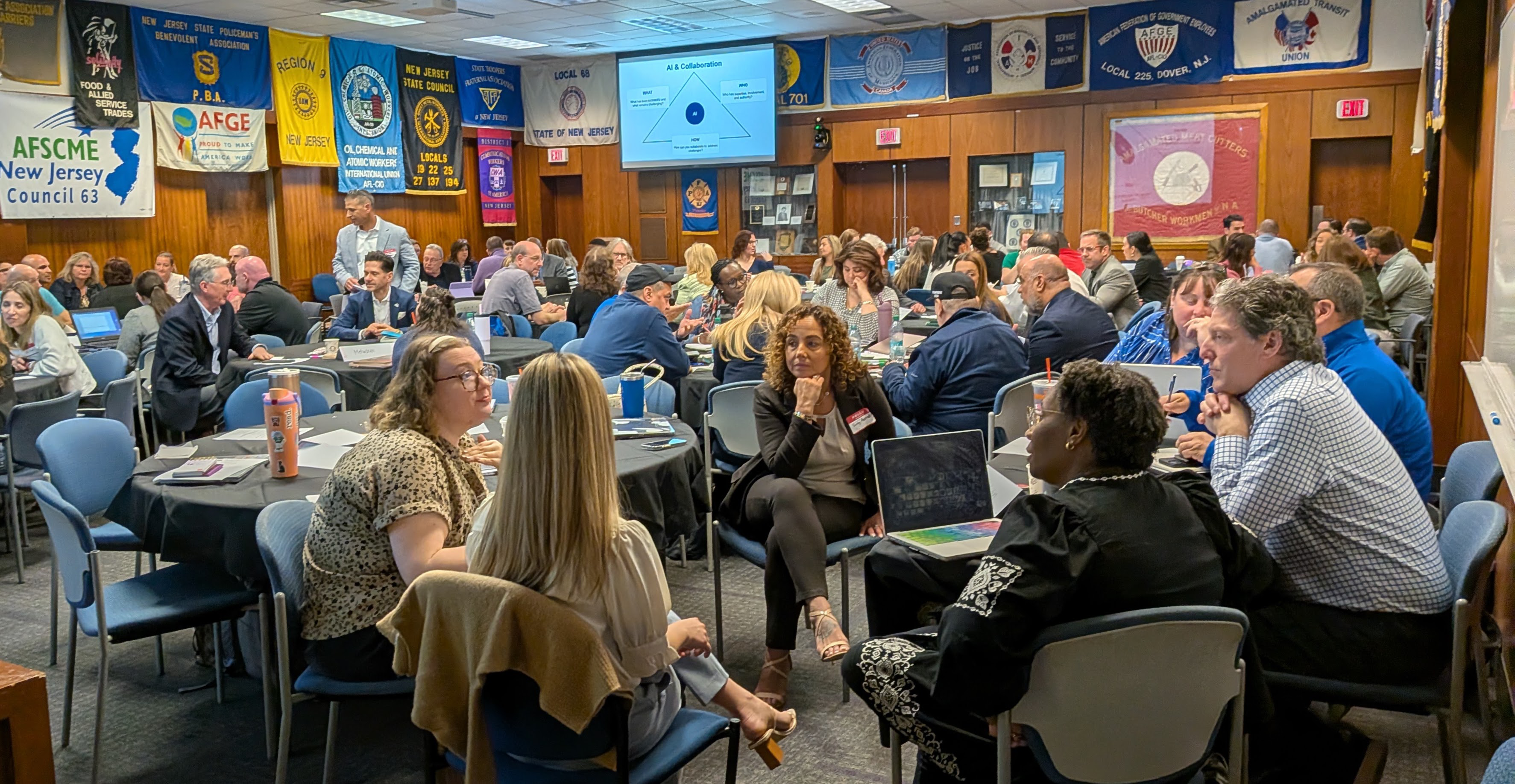
On April 24, 2026 we held our 16th Inter-District Conference, including 160 Participants from 13 NJ Districts. The conference focused on collaborative approaches to two acute problems currently experienced by educators: the use of AI in teaching and learning; and challenging behaviors in elementary schools.
3. Training for peer facilitators
Peer facilitators help deliver the Capacity-Building Workshops and also provide as-needed support for districts and schools, and leaders in navigating the Collaborative process. They include Superintendents, Union Leaders, Central Office Administrators, Board Members, Teachers, Principals, and Supervisors.
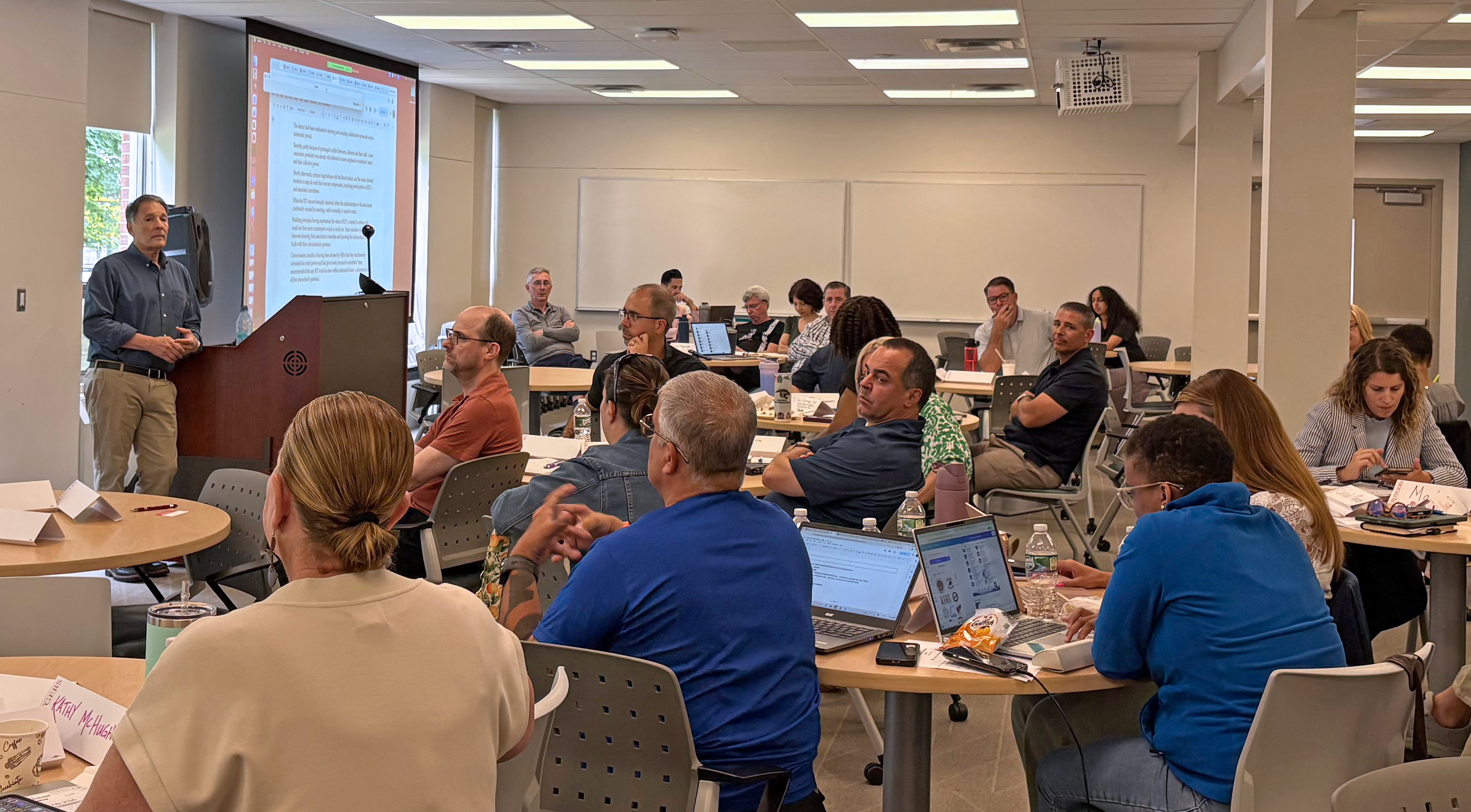
On June 25 and 26, 2026 we held the 11th PSC Facilitator Workshop. It included 29 Facilitators from 7 NJ Public School Districts. This was the 3rd two-day session we have held over the past 18 months - including both NJ Facilitators and 35 South African Facilitators from across all 9 Provinces in conjunction with the South African Education Labour Relations Council (ELRC).
Research Partnerships:
We have been engaged in research partnerships with the Rutgers Cornwall Center for Metropolitan Studies; Rutgers Bloustein School of Public Policy; Newark Public Schools; Rutgers School of Management and Labor Relations; Rutgers Dept. Urban Education; and 2 South African Universities.
Research by the Rutgers Cornwall Center for Metropolitan Studies, directed by Distinguished Professor Charles Payne, focuses specifically on the impact of Collaborative Partnerships on urban schools. We are particularly interested in student achievement, graduation and drop-out rates, attendance, discipline, teacher efficacy, turnover and retention, school culture and climate.
Joining in this research are colleagues from the Rutgers Department of Urban Education, Rutgers Bloustein School of Public Policy, and the Rutgers Department of Sociology – assisted by graduate students.
Preliminary results have been highly encouraging and consistent with previous research conducted in other districts across the country, linking collaboration with improved student performance, increased teacher retention, and other positive outcomes in school culture and climate.
We are now formalizing research partnerships with two South African universities to conduct joint comparative research on the implementation and impact of the PSC model of Collaborative Partnerships on both sides of the Atlantic. This will be funded in part by our grant from Rutgers Global.
Recent Publications:
- Democracy and Reform in Public Schools: The Case for Collaborative Partnerships. Rubinstein, Heckscher, and McCarthy. Harvard Education School Press, 2024.
- “Stakeholder Partnership Institutions at Work – A Look at Theory and Practice: The Case of Public Education.” Heckscher and Rubinstein. In Collective Voice in the 21st Century: Advancing Social Justice at Work, edited by Batt, Cutcher-Gershenfeld, Frost, and MacDuffie. Cornell University Press (forthcoming 2026).
- "Building a Collaborative Enterprise," Adler, Heckscher, and Prusak. Included in a Harvard Business Review Special Issue "How to Collaborate Better," 2026.

Plans for the 2026-27 school year
Capacity-Building
We expect to deliver daylong capacity building sessions for 3-4 new districts and 10-15 experienced districts, or over 100 schools.
Inter-District Conferences
We are planning two state-wide conferences in the coming year:
-
In December we will hold a conference on the future of public education in New Jersey, co-sponsored with the Rutgers Bloustein School for Public Policy and the Rutgers Cornwall Center for Metropolitan Studies.
-
In the Spring we will hold our annual inter-district conference for all our New Jersey districts.
The Research Background
For four decades the national debate over public school reform has created friction among teachers unions, administrators, school boards, parents, policymakers, and other stakeholders in public education and has fueled disagreements over how to improve the quality of teaching and learning for children. Division among the key stakeholders has been a key obstacle to progress.
Research by the Center's faculty published in 2011 examined cases of school reform across the country and identified elements that all school districts with long-term union-management partnerships shared in common. Further research in 25 districts across 6 states demonstrated that formal union-management committees and collaborative partnerships improve student achievement even in high poverty schools. These partnerships lead to more extensive collaboration among teachers as well as between teachers and administrators. Specifically they found the following benefits from collaborative partnerships:
- Improved student performance. The quality of formal partnerships between teachers unions, administrators, and teachers at the school level is a significant predictor of student performance, as well as performance improvement, after poverty and school type are taken into account. This improvement is associated with increases in various dimensions of communication.
- More extensive communication among teachers about ways to improve teaching and learning. Higher-quality, school-level teacher-administrator partnerships predicted more extensive school-level collaboration and communication around: student- performance data; curriculum development, cross-subject integration, or grade- to-grade integration; sharing, advising, or learning about instructional practices; and giving or receiving formal or informal mentoring.
- More frequent and positive communication between union representatives and principals. Finally, the quality of partnerships predicted different communication patterns between union building representatives and principals, with the communication in high-partnership schools becoming more frequent and less formal than the communication in low- partnership schools.
- Enhanced learning among schools and the adoption of innovation from one school to another. Achievement tests can reveal deficiencies in student knowledge, but they can offer little more beyond alerting parents and teachers to a problem. Collaborative partnerships, because they are problem focused, can take the critical next steps and help drive thinking about ways to increase student learning. These types of partnerships are designed to use collaboration among educators to find solutions to gaps in student achievement and then effectively implement those solutions because those closest to the problem – with tacit knowledge of it – are key stakeholders in the improvement process.
Another benefit has become increasingly important in recent years:
- Dramatic reduction in teacher turnover and intention to leave the profession – especially in high-poverty schools, which are particularly plagued by high turnover. When teachers feel that their voice is heard and are involved in improving education in the classroom, they are much less likely to experience dissatisfaction and loss of commitment.
- Rubinstein, Saul, Charles Heckscher, and John McCarthy. 2024. Democracy and Reform in Public Schools: The Case for Collaborative Partnerships. Cambridge, MA: Harvard Education School Press.
- Heckscher, Charles. 2021. “Changing Demands on Leadership.” Psychoanalytic Inquiry, October.
- Rubinstein, Saul A., and John E. McCarthy. 2021. “The Future of US Public School Reform: Elevating Teacher Voice.” In Revaluing Work(Ers): Toward a Democratic and Sustainable Future, edited by Tobias Schulze-Cleven and Todd E. Vachon. Lera Research Volume. Ithaca, NY: Cornell University Press.
- Rubinstein, Saul A., and John E. McCarthy. 2016. “Union–Management Partnerships, Teacher Collaboration, and Student Performance.” ILR Review 69 (5): 1114–32.
- McCarthy, John, and Saul Rubinstein. 2015. “The Teachers’ Union as a Knowledge Network: Evidence from United States Public Schools.”
- Heckscher, Charles. 2015. “From Bureaucracy to Networks.” In The Sage Handbook of the Sociology of Work and Employment, edited by Stephen Edgell, Heidi Gottfried, and Edward Granter, 245. Sage.
- Heckscher, Charles. 2015. Trust in a Complex World: Rebuilding Community. Oxford (UK): Oxford University Press.
- Rubinstein, Saul. 2014. “Partnerships, Collaboration, and Student Achievement.” October 9.
- Rubinstein, Saul A., and John E. McCarthy. 2014. “Teachers Unions and Management Partnerships: How Working Together Improves Student Achievement.” Center for American Progress.
- Adler, Paul S., Charles Heckscher, John McCarthy, and Saul A. Rubinstein. 2014. “The Mutations of Professional Responsibility: Toward Collaborative Community.” In Professional Responsibility: The Fundamental Issue in Education and Healthcare Reform, edited by Douglas E. Mitchell and Robert K. Ream. Switzerland: Springer International Publishing.
- “Strengthening Partnerships: How Communication and Collaboration Contribute to School Improvement,” Saul A. Rubinstein, American Educator, (Circulation 900,000), Washington, DC. Volume 37, Issue 4, p22-28, Winter 2013-2014.
- Rubinstein, Saul. Fall, 2013. “An Organizational and Industrial Relations Perspective on US Public School Reform: Union-Management Partnerships, Teacher Collaboration and Student Performance.”
- McCarthy, John E., Heather E. J. McCarthy, and Saul A. Rubinstein. 2012. “The Social Antecedents to Innovative Climate: A Social Network Analysis in a United States Public School District.” Rutgers University.
- Adler, Paul, Charles Heckscher, and Laurence Prusak. 2011. “Building a Collaborative Enterprise.” Harvard Business Review 89 (7/8): 94–101.
- Rubinstein, Saul A., and John E. McCarthy. 2012. “Public School Reform Through Union-Management Collaboration.” In Advances in Industrial and Labor Relations, edited by Lewin David and J. Gollan Paul, 20:1–50. Advances in Industrial & Labor Relations. Emerald Group Publishing Limited.
- Rubinstein, Saul, Charles Heckscher, and Paul Adler. 2011. “Moving beyond ‘Blame the Teacher.’” Los Angeles Times, September 16, 2011.
- Rubinstein, Saul A., and John E. McCarthy. 2011. “Reforming Public School Systems through Sustained Union-Management Collaboration.” Center for American Progress, July. http://files.eric.ed.gov/fulltext/ED536074.pdf.
- Rubinstein, Saul A., and Adrienne E. Eaton. 2009. “The Effects of High-Involvement Work Systems on Employee and Union–Management Communication Networks.” Edited by David Lewin and Bruce E. Kaufman. Advances in Industrial & Labor Relations 16: 109–36.
- Heckscher, Charles. 2007. The Collaborative Enterprise. New Haven, CT: Yale University Press.
- Rubinstein, Saul A., and Charles Heckscher. 2003. “Partnerships and Flexible Networks: Alternatives or Complementary Models of Labor-Management Relations?” In Negotiations and Change: From Workplace to Society, edited by Thomas A. Kochan and David B. Lipsky, 189–204.
- Rubinstein, Saul A. 2001. “The Local Union Revisited: New Voices from the Front Lines.” Industrial Relations 40 (3): 405.
- Heckscher, C. 2001. “Participatory Unionism.” Labor Studies Journal 25 (4): 3.
- Rubinstein, Saul A., and Thomas A. Kochan. 2001. Learning from Saturn : Possibilities for Corporate Governance and Employee Relations. Ithaca: ILR Press.
- Rubinstein, Saul A. 2000. “The Impact of Co-Management on Quality Performance: The Case of the Saturn Corporation.” Industrial & Labor Relations Review, 197–218.
- Kochan, Thomas A., and Saul A. Rubinstein. Jul. - Aug, 2000. “Toward a Stakeholder Theory of the Firm: The Saturn Partnership.” Organization Science 11 (4): 367–86.
- Rubinstein, Saul, Michael Bennett, and Thomas Kochan. 1993. “The Saturn Partnership: Co-Management and the Reinvention of the Local Union.” In Employee Representation: Alternatives and Future Directions, edited by Bruce Kaufman and Morris Kleiner, 339–70. Madison, WI: Industrial Relations Research Association.